



Stages of debt collection under bank loan agreements in activities of "Fund for Problem Loans” JSC
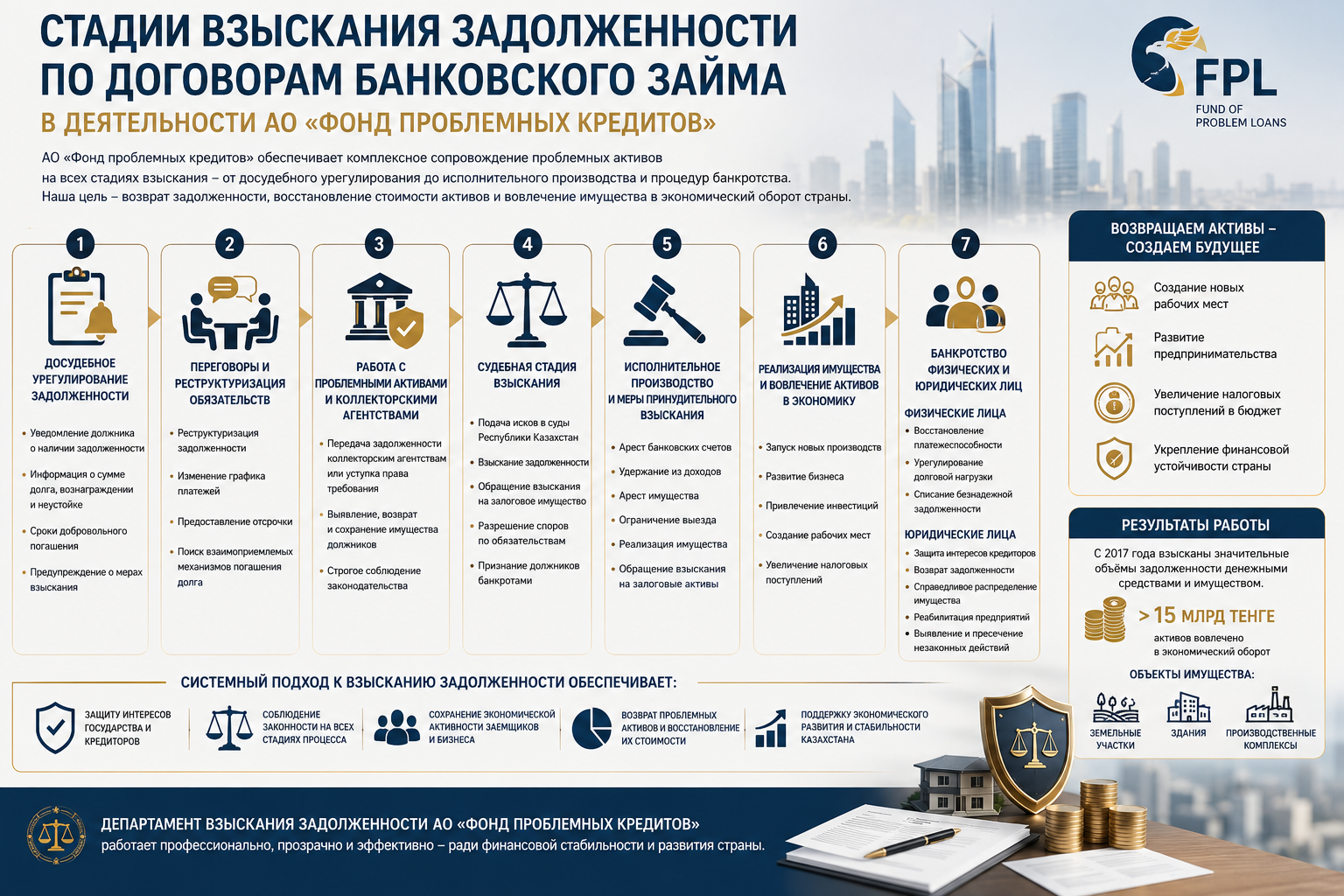
In modern economic conditions, effective debt collection has particular importance for stabililty of financial system of the Republic of Kazakhstan. One of key participants in this work is “Fund of Problem Loans” JSC, which carries out comprehensive activities to repay problem debts, restore assets value and involve property into country’ economic turnover.
Fund’s Debt Collection Department carries out systematic work to support distressed assets at all recovery stages — from pre-trial settlement to enforcement proceedings and bankruptcy procedures. Recovered funds and property contribute to creation of new jobs, development of entrepreneurship and increase in tax revenues to the budget.
Pre-trial debt settlement
Primary stage of recovery is pre-trial work with debtors. At this stage, Fund carries out activities aimed at voluntary fulfillment of obligations without appeal to court.
In case of overdue debt, debtor receives a notice, containing: (1) information on debt amount; (2) amount of accrued remuneration and penalties; (3) terms of voluntary repayment; (4) warning about possible penalties.
Special attention is paid to compliance with requirements of the legislation of the Republic of Kazakhstan at interaction with individuals.
Negotiations and restructuring of liabilities
One of important tools in Fund’s work is debt settlement through negotiations with borrowers.
Depending on debtor’s financial condition, the following may be applied: (1) debt restructuring; (2) changing payment schedule; (3) granting deferral; (4) search for mutually acceptable debt repayment mechanisms.
This approach helps maintaining borrowers’ economic activity and increase probability of debt repayment.
Dealing with distressed assets and collection agencies
In cases the debtor evades fulfilling obligations, Fund has the right to use collection mechanisms provided for by law, including transfer of debt to collection agencies or assignment of claim right.
With that, activities of collection agencies are carried out strictly within the framework of legislation and under control of authorized bodies.
Fund also actively works to identify, return and preserve debtors’ property. Significant part of recovery actions is carried out not only in cash, but also in property transferred to Fund’s balance sheet.
Judicial stage of recovery
If pre-trial measures do not lead to a result, Fund initiates judicial debt collection.
Claims are filed to courts of the Republic of Kazakhstan in accordance with procedural legislation requirements. The following is considered in court: (1) claims for debt collection; (2) foreclosure on pledged property; (3) disputes related to performance of obligations; (4) declaring debtors bankrupt.
Judicial proceedings are important mechanism for protecting interests of creditors and ensuring legality of the recovery procedure.
Enforcement proceedings and enforcement measures
After entry of court jungment into force, enforcement documents are sent to bailiffs for enforcement.
The following measures are applied in the framework of enforcement proceedings: (1) seizure of bank accounts; (2) withholding funds from debtor’s income; (3) seizure of movable property and real estate; (4) restriction to travel outside Republic of Kazakhstan; (5) sale of property; (6) foreclosure on collateral assets.
The most common way to secure obligations is pledge of real estate, land, production facilities and vehicles.
Sale of property and involvement of assets in economy
One of priorities in Fund’s activities is involvement of returned assets in economic turnover. Sold property is used for: (1) launching new production facilities; (2) business development; (3) attracting investments; (4) creation of jobs; (5) increase in tax revenues.
In recent years, assets worth over 15 billion tenge, including land, buildings and industrial complexes, have been involved in economic turnover. New investment and entrepreneurial projects are implemented at these facilities.
Bankruptcy of individuals
Fund also works with individuals on debt settlement and bankruptcy procedures.
Since 2023, bankruptcy of individuals has been operating in Kazakhstan, allowing citizens, on grounds provided for by law: (1) undergo solvency restoration procedure; (2) settle debt burden; (3) write off bad debts.
Fund’s specialists consult citizens, explaining legal mechanisms for debt settlement.
Bankruptcy and rehabilitation of legal entities
In relation to legal entities, Fund participates in bankruptcy and rehabilitation procedures for enterprises. Main objectives of these procedures are: (1) protect creditors’ interests; (2) debt repayment; (3) fair distribution of debtor’s property; (4) restoration of enterprise solvency if there are prospects for rehabilitation.
In cases of detecting signs of deliberate bankruptcy, concealment of property or other illegal actions, measures are taken within the framework of current legislation of the Republic of Kazakhstan.
Results of Debt Collection Department’s work
Debt Collection Department of “Fund of Problem Loans” JSC demonstrates steady positive trend.
Since 2017, significant amounts of debt have been collected, both in cash and property, and transferred to Fund’s balance sheet. Significant part of recovered assets has already been involved in economic turnover and is used to implement new projects in country’s regions.
Integrated approach to debt collection allows Fund not only to ensure return of distressed assets, but also to perform important socio-economic function, contributing to development of economy and strengthening financial stability of Kazakhstan.
Debt collection system in Fund’s activities is a consistent set of legal and organizational mechanisms aimed at effective resolution of problematic debts and protecting interests of the state and creditors.
Pre-trial work, judicial recovery, enforcement proceedings, support of bankruptcy procedures and involvement of assets into economy are interrelated elements of single system that ensures recovery of distressed assets and supports country’s economic stability.