



Fund's Legal Department: legal support and monitoring of legislative changes
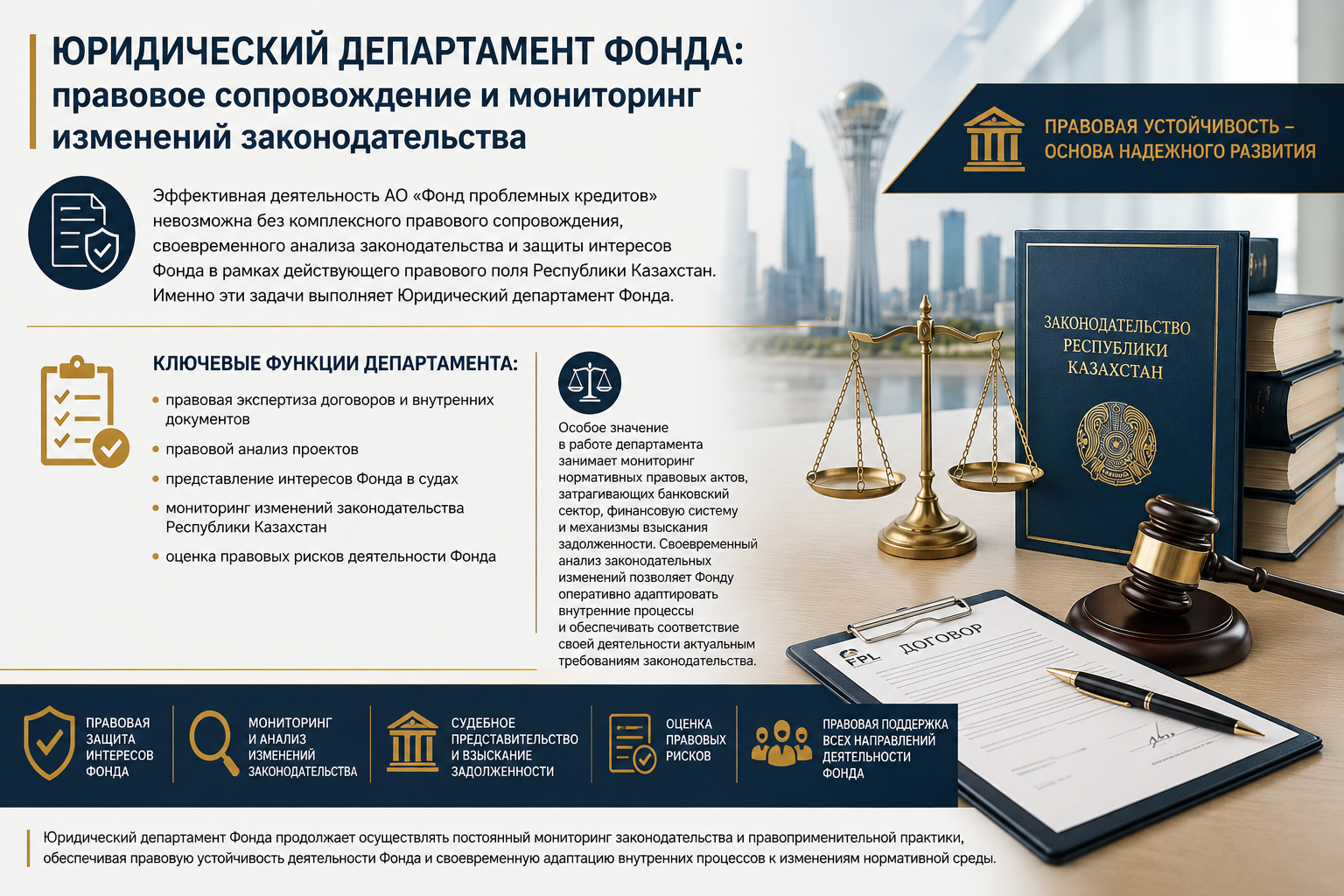
Effective operation of “Fund of Problem Loans” JSC (hereinafter referred to as Fund) is impossible without comprehensive legal support, timely analysis of legislation and protection of Fund’s interests within current legal framework of the Republic of Kazakhstan. These are the tasks performed by Fund’s Legal Department.
Legal Department provides legal support for all areas of Fund’s activities. Department’s key functions are: legal review of contracts and internal documents; legal analysis of projects; representation of Fund’s interests in courts; monitoring of changes in legislation of the Republic of Kazakhstan; assessment of legal risks in Fund’s activities.
Monitoring of regulatory legal acts affecting banking sector, financial system and debt collection mechanisms is of particular importance in department’s work. Timely analysis of legislative changes allows Fund to quickly adapt internal processes and ensure that its activities comply with current legal requirements.
Analysis of new Law of the Republic of Kazakhstan “On Banks and Banking activities in the Republic of Kazakhstan”
As part of monitoring regulatory legal acts, Fund’s Legal Department analyzed norms of new Law of the Republic of Kazakhstan “On Banks and Banking Activities in the Republic of Kazakhstan” dated January 16, 2026, which entered into force on March 19, 2026 (hereinafter referred to as Law).
New law provides for large-scale update of banking sector regulation and forms modern model of risk-based supervision aimed at increasing banking system stability and strengthening protection of financial services consumers.
One of key changes was introduction of multi-level model of banking regulation.
Law provides for two types of banking licenses:
– universal license — for banks performing a full range of banking operations;
– basic license — for banks with limited list of operations and reduced capital requirements.
This approach is aimed at creating more flexible banking ecosystem, developing competition and expanding access to financial services.
Significant changes have been made to protection mechanisms for borrowers and consumers of financial services.
In particular, Law prohibits currency indexation of loans issued in national currency; limits number of penalties on liabilities and strengthens pre-trial dispute resolution mechanisms.
Special attention is paid to financial ombudsman institution. According to the Law, Financial Ombudsman’s decisions become mandatory for banks upon client’s consent, that strengthens the role of out-of-court dispute resolution.
For the first time, Islamic banking operations have been regulated in detail at the legislative level.
Law provides for mandatory separate accounting of assets; creation of Islamic finance council; separate requirements for Islamic financial transactions.
Development of Islamic banking is aimed at expanding financial instruments and attracting new investments into Kazakhstan’s economy.
Law introduces three-tier system of banks’ supervision, including: enhanced surveillance mode; financial stability restoration mode; troubled bank settlement mode.
Settlement mechanism provides for modern financial stabilization tools, including: bail-in (write-off or conversion of liabilities into equity); forced sale of bank to investor; creation of stabilization bank.
With that, government participation is allowed only after possible losses are covered by bank’s capital and internal instruments.
New law establishes distinction between micro and macroprudential regulation.
National Bank of the Republic of Kazakhstan has received authority to set macroprudential limits, including: borrower’s debt burden ratio; countercyclical buffer and other instruments for limiting system risks.
Authorized body, in turn, monitors compliance with established requirements.
Law also establishes mechanisms of digital transformation of banking system.
Key innovations include mandatory biometric authentication at applying for the first online loans; use of electronic trading platforms for sale of collateral and further development of digital financial services.
These changes are aimed at increasing transparency of banking operations, reducing fraud risks and developing modern digital tools.
In essence, new Law forms transition from regulatory model focused primarily on licensing banking activities to sustainable banking model based on risk management, financial stability and consumer protection.
Systemic analysis of such legislative changes is of great practical importance, since Fund’s activities are directly related to banking sector, support of distressed assets, debt collection and financial recovery mechanisms.
Fund’s Legal Department continuously monitors legislation and law enforcement practices, ensuring legal stability of Fund’s activities and timely adaptation of internal processes to changes in regulatory environment.