



Nonperforming Loans in Asia: Key Insights from ADB and KAMCO Experts at the 9th IPAF Training Seminar
In May 2026, the 9th Training Seminar of the International Public AMC Forum (IPAF) was held, covering a broad range of topics: from the resolution of distressed household and microenterprise debt to modern NPL valuation methodologies, digitalization of asset management processes, and the development of investment and market infrastructure.
The seminar brought together representatives of public asset management companies, financial institutions, and international experts to discuss key challenges facing the banking sector amid continued global uncertainty.
One of the seminar’s keynote presentations was delivered by Peter Rosenkranz, Senior Financial Sector Specialist at the Asian Development Bank (ADB), who addressed the relationship between macroeconomic shocks, asset quality, and the resilience of financial systems across Asia.
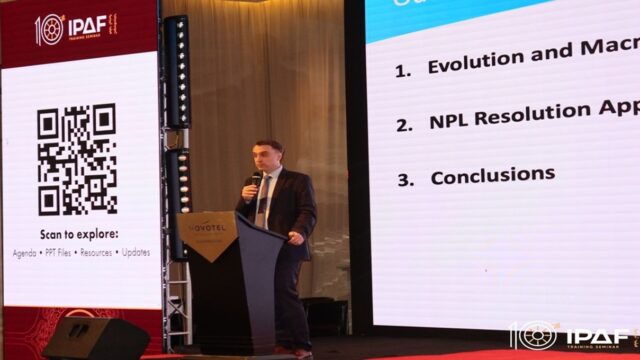
In his presentation, Mr. Rosenkranz noted that financial systems across the region continue to face pressure from inflationary trends, higher borrowing costs, geopolitical tensions, and slowing global economic growth. According to him, these factors directly contribute to rising credit risks, particularly in the small and medium-sized enterprise (SME) segment and the real estate sector.
Particular attention was given to the relationship between rising nonperforming loans and slower economic growth. It was emphasized that the accumulation of NPLs has a systemic impact on the banking sector by weakening balance sheet quality, reducing lending activity, and limiting the capacity of banks to finance the real economy. Discussions also highlighted that nonperforming loans are not only a consequence of deteriorating economic conditions but also an independent source of financial instability. The buildup of NPLs can constrain credit expansion, reduce investment activity, and thereby reinforce negative macroeconomic trends.
In this context, the speaker emphasized the importance of timely recognition of distressed assets and the implementation of effective resolution mechanisms, including the role of asset management companies (AMCs), which play a critical role in cleaning up bank balance sheets and restoring financial stability. At the same time, it was noted that the effectiveness of such mechanisms largely depends on the quality of the legal framework, the transparency of asset transfer procedures, and the overall macroeconomic environment.
A key theme throughout the seminar was the transition from responding to already accumulated distressed assets toward systems focused on early identification and monitoring of emerging risks. Participants noted that, in an increasingly complex macroeconomic environment, effective NPL management depends not only on resolution mechanisms but also on the ability of financial institutions to identify potential risks in a timely manner and assess their implications for banking sector resilience.
The second keynote presentation was delivered by HyeJin Lee of KAMCO’s International Cooperation Department, who introduced the NPL Watch Asia 2026 report, one of the region’s most comprehensive tools for monitoring nonperforming loans.
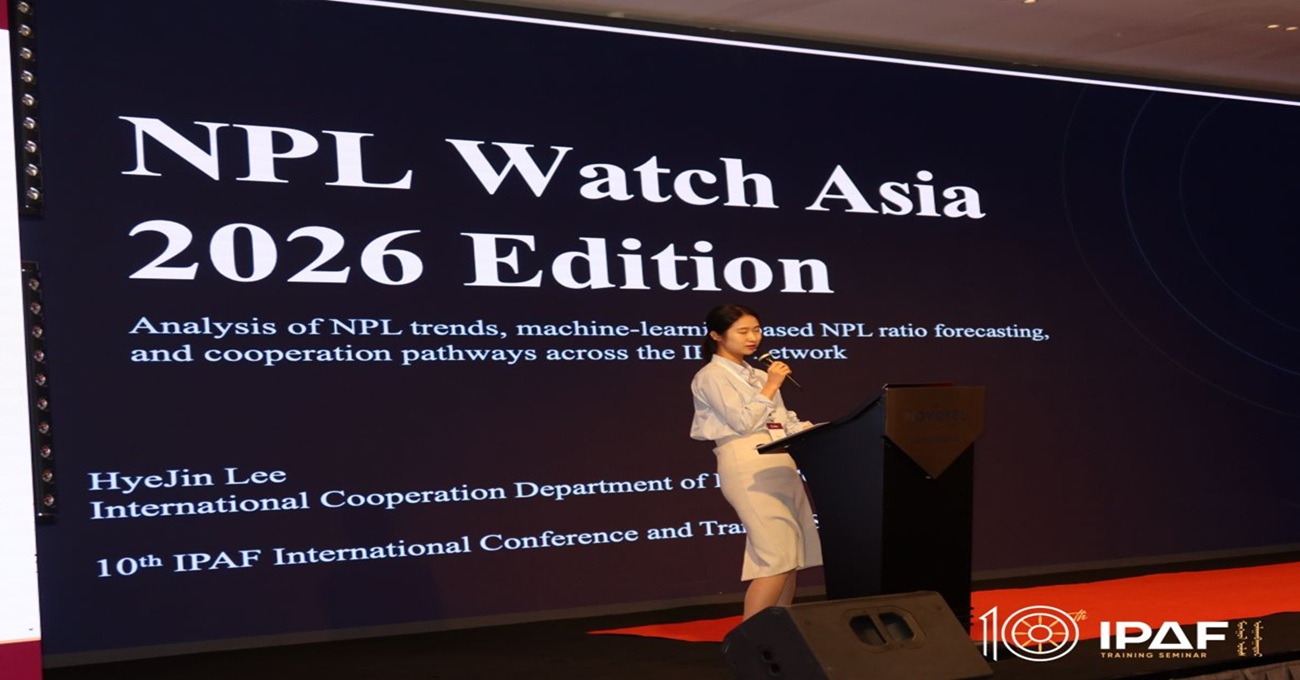
During the presentation, it was noted that the 2026 edition significantly expanded its analytical scope: the number of economies covered increased from 20 to 25, while the methodology was enhanced through the inclusion of additional banking and macro-financial indicators. In addition to analyzing NPL trends, the report also assesses banking sector resilience, provisioning quality, and capital adequacy, enabling a more comprehensive evaluation of potential financial stability risks.
According to the report, the total volume of nonperforming loans in Asia reached USD 821 billion in 2025, representing an 11.5% increase compared to the previous year. At the same time, the regional average NPL ratio increased only marginally, from 1.60% to 1.63%. According to KAMCO experts, this trend demonstrates that risks within the financial system are not always fully reflected in relative asset quality indicators. Even when NPL ratios remain stable, expanding credit portfolios may be accompanied by a significant increase in the absolute volume of distressed debt, requiring additional attention from regulators and development institutions.
The report also highlighted the impact of persistently elevated interest rates, rising household debt burdens, conditions in real estate markets, and the geo-economic fragmentation of the global economy. According to the experts, these factors may become key drivers of credit risk growth in specific countries and sectors over the medium term.
Particular interest was generated by KAMCO’s machine learning-based forecasting module, designed to predict NPL trends across regional economies over the coming quarters. The model incorporates macroeconomic indicators, banking sector liquidity, capital adequacy levels, provisioning data, and a range of external factors. The use of such analytical tools enables not only an assessment of the current condition of the banking sector but also the timely identification of potential areas of risk.
A separate section of the presentation focused on structural factors affecting the effectiveness of distressed asset resolution. Among the key prerequisites identified were the development of secondary NPL markets, improvements in legal infrastructure, institutional readiness of specialized organizations, and enhanced data transparency.
At the conclusion of the seminar, participants agreed that effective distressed asset management in today’s environment requires a comprehensive approach combining timely risk identification, the development of legal and market infrastructure, the use of advanced analytical and forecasting tools, and stronger international cooperation.
In this regard, IPAF continues to serve as an important platform for knowledge sharing, professional capacity building, and the development of practical solutions in the field of distressed asset management.
Prepared by Dina Abildayeva
Chief Specialist of the Strategy,
Analytics and Government Relations Division
Corporate Development Department
Fund of Problem Loans JSC
